


 By
By You’ve decided you want to get in shape. Maybe you’re tired of feeling out of breath on the stairs, maybe you want more energy, or maybe you just caught your reflection and thought, “It’s time.” Whatever sparked it, you’re motivated — and that’s wonderful.
But then comes the overwhelm. Should you lift weights or do cardio? How many days a week? What about all those complicated programs online? Do you need a gym membership, special equipment, a perfect diet? The flood of conflicting advice is enough to make anyone quit before they even begin.
Take a deep breath. Learning how to start working out is genuinely simpler than the fitness industry wants you to believe. You don’t need to be perfect, expensive, or extreme. You just need a sensible plan and the willingness to begin. Let’s build that plan together — one that you’ll actually stick with.
Why Most Beginners Quit (And How to Avoid It)
Before the how-to, let’s address the elephant in the room: most people who start an exercise routine quit within a few weeks. Understanding why is your secret weapon for being one of the ones who doesn’t.
The number one reason beginners fail is doing too much, too soon. Fueled by motivation, they leap into intense daily workouts, end up exhausted and sore, dread the next session, and burn out fast. The second big reason is the all-or-nothing trap — missing one workout, deciding they’ve “blown it,” and abandoning the whole effort.
The antidote to both is the same: start smaller than you think you need to, and aim for consistency over intensity. A modest workout you’ll actually repeat 100 times beats a brutal one you’ll do twice and quit. Burn that into your mind, because it’s the single most important principle in this entire guide.
Step 1: Get Clear on Your “Why”
Motivation fades. Everyone feels fired up on day one; almost nobody feels fired up on a cold, tired Tuesday three weeks in. What carries you through those moments isn’t fleeting motivation — it’s a clear, personal reason.
Take a minute to ask yourself why you really want this. “To look good” is fine, but dig deeper. Do you want energy to play with your kids? To feel confident? To protect your health for the long run? To prove something to yourself? Write your reason down and keep it somewhere visible. On the days you don’t feel like it, your “why” is what gets your shoes on. It’s the engine beneath the whole journey.
Step 2: Start With Just Two or Three Days a Week
Here’s permission you may not expect: you do not need to work out every day. In fact, as a beginner, you shouldn’t. Your body needs rest days to recover and grow stronger — that’s when the actual adaptation happens.
Start with two or three workout days per week, with rest days in between. That’s it. This is enough to make real progress while keeping the commitment small enough that you’ll actually follow through. It also leaves you wanting a little more, which is far better than dreading it. You can always add days later as it becomes a natural part of your week. Begin conservatively; your future self will thank you.
Step 3: Combine the Three Pillars of Fitness
A well-rounded routine rests on three pillars. You don’t need to master all of them at once, but knowing them helps you build a balanced plan over time.
The first is cardiovascular exercise — anything that raises your heart rate, like brisk walking, cycling, swimming, or dancing. It strengthens your heart and lungs and boosts energy and mood.
The second is strength training — using resistance to build muscle, whether through your own bodyweight, resistance bands, or weights. This is crucial: muscle keeps your metabolism healthy, protects your joints, and becomes even more important as you age.
The third is flexibility and mobility — stretching, yoga, or gentle movement that keeps you limber and helps prevent injury.
As a beginner, a simple mix of some walking, some basic strength work, and a little stretching covers all three beautifully.
Step 4: A Simple Beginner Workout You Can Do Anywhere
Let’s make this concrete. Here’s a gentle full-body routine that needs no equipment and can be done at home. Always begin with a five-minute warm-up — marching in place, arm circles, gentle movement to get your blood flowing.
Then try these foundational moves, doing what you can with good form:
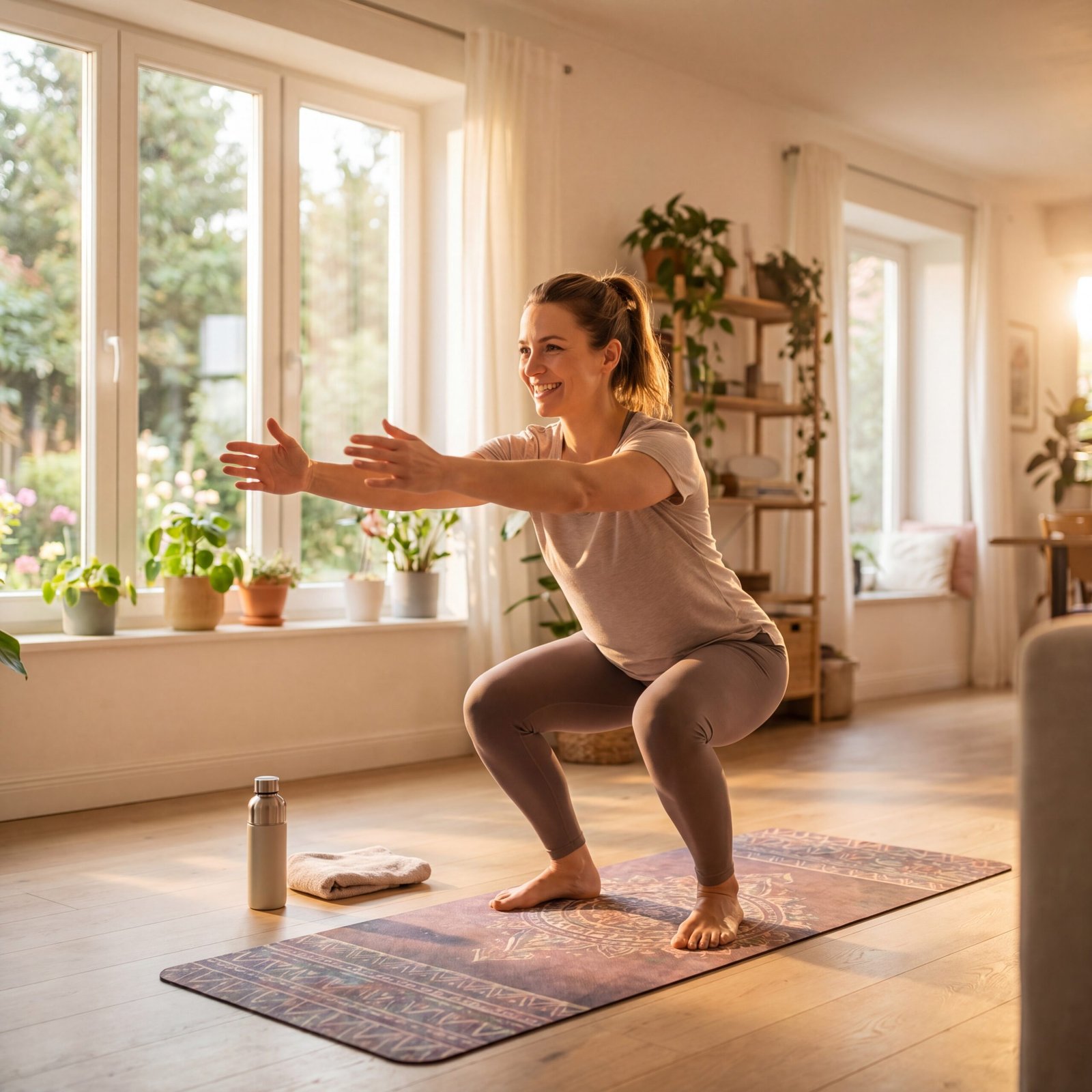
Bodyweight squats — stand with feet shoulder-width apart and sit back as if lowering into a chair, then stand. Start with 8 to 10.
Wall or knee push-ups — push-ups against a wall or with knees on the floor build upper-body strength gently. Aim for 5 to 10.
Glute bridges — lie on your back, knees bent, and lift your hips toward the ceiling, then lower. Try 10 to 12.
Standing marches or gentle step-ups — to keep the heart rate up, march in place with high knees for 30 seconds.
A plank hold — hold a straight-body position on forearms and toes (or knees) for 10 to 20 seconds.
Move through these once as a beginner, rest as needed, and finish with a few minutes of gentle stretching. As you get stronger, do a second round. That’s a complete, balanced workout — and it costs nothing.
Step 5: Master the Art of Warming Up and Cooling Down
It’s tempting to skip these, but they protect you from the injuries and soreness that derail so many beginners. A warm-up gradually raises your heart rate and loosens your muscles, preparing your body to work safely. Spend five minutes on light movement before every session.
A cool-down does the reverse, easing your body back to rest and improving flexibility. Spend a few minutes after each workout doing gentle stretches, holding each for 15 to 30 seconds without bouncing. These bookends take only a few minutes combined, but they make the difference between a sustainable habit and a painful start-stop cycle.
Step 6: Listen to Your Body — Know Good Pain From Bad Pain
This is vital for staying safe and confident. As a beginner, you’ll feel things, and it helps to know which sensations are normal and which are warnings.
“Good” discomfort includes muscles feeling worked or tired during exercise, and mild soreness a day or two afterward — that’s your body adapting and getting stronger. “Bad” pain is sharp, sudden, or stabbing; pain in a joint rather than a muscle; or anything that makes you feel dizzy, nauseous, or genuinely unwell. That kind of pain is a signal to stop.
Pushing through good fatigue is fine. Pushing through bad pain causes injury. When in doubt, ease off. There’s no prize for hurting yourself, and an injury is the fastest way to lose your momentum.
Step 7: Fuel and Hydrate Your Body
Exercise and nutrition work as a team. You don’t need a complicated diet to start, but a few basics make a big difference. Stay hydrated — drink water before, during, and after your workouts. Even mild dehydration saps your strength and energy.
Eat enough real food to fuel your activity, with a balance of protein to help muscles recover, carbohydrates for energy, and plenty of fruits and vegetables. You don’t have to eat “perfectly.” As you build the exercise habit, healthier food choices often follow naturally. For now, just don’t try to work out on empty or starve yourself — your body needs fuel to get stronger.
Step 8: Track Progress Beyond the Scale
Here’s something that saves countless beginners from quitting: the scale is a terrible judge of your progress. Weight fluctuates daily for dozens of reasons, and early fitness gains often don’t show up there at all. If you measure success only by a number, you may give up right when great things are happening inside you.
Instead, notice the wins the scale can’t see. Are you less out of breath on the stairs? Sleeping better? Feeling more energetic and less stressed? Able to do more reps than last week? Lifting something that used to feel heavy? These are the real signs your body is transforming. Keep a simple log of your workouts so you can look back and see how far you’ve come. That visible progress is powerful fuel.
Step 9: Build the Habit, Not Just the Workout
Ultimately, fitness success is a habit-building game. The goal isn’t one great workout — it’s becoming the kind of person who moves regularly. A few tricks make habits stick: schedule your workouts like appointments, lay out your clothes the night before to lower the friction, and pair exercise with something you enjoy, like a favorite playlist or podcast.
And when you inevitably miss a day — because life happens — never let one miss become two. Don’t punish yourself or declare the whole effort ruined. Just show up for the next session. Consistency over time, not perfection in any single week, is what reshapes your body and your life.
Your First Step Is the Most Important One
Everything in this guide can be summed up simply: start small, stay consistent, and be kind to yourself. You don’t need a fancy gym, a perfect plan, or a dramatic transformation overnight. You need to begin, and then keep showing up.
The hardest workout you’ll ever do is the first one, because it requires overcoming inertia and self-doubt. But once you start, momentum builds. Each session makes the next one easier. Within a few weeks, you’ll feel stronger and more energized. Within a few months, you may not recognize the person who once felt overwhelmed just thinking about exercise.
So don’t wait for the perfect moment or the perfect plan — they don’t exist. Put on your shoes, do that simple beginner routine, and take your first step today. Your stronger, healthier, more confident self is waiting on the other side of starting. You’ve absolutely got this.
This article is for general educational purposes and isn’t a substitute for professional medical advice. If you have any health conditions, injuries, or concerns, please consult a doctor before beginning a new exercise program.